Financial Inclusion and Consumer Awareness: Key Insights from the Ombud Council Stakeholder Conference 2026
Financial inclusion is not simply about giving people access to financial products and services. It is also about ensuring that consumers know their rights, understand where to seek assistance and have access to fair and accessible dispute-resolution mechanisms when things go wrong.
This was among the important issues highlighted at the Ombud Council Stakeholder Conference 2026, held on 12 November 2026 in Sandton, South Africa.
Under the theme “Tracking Progress Towards a Simpler, Stronger Financial Sector Ombud System”, the conference brought together stakeholders to consider the progress being made towards strengthening the financial-sector ombud system.
Understanding the Consumer Experience
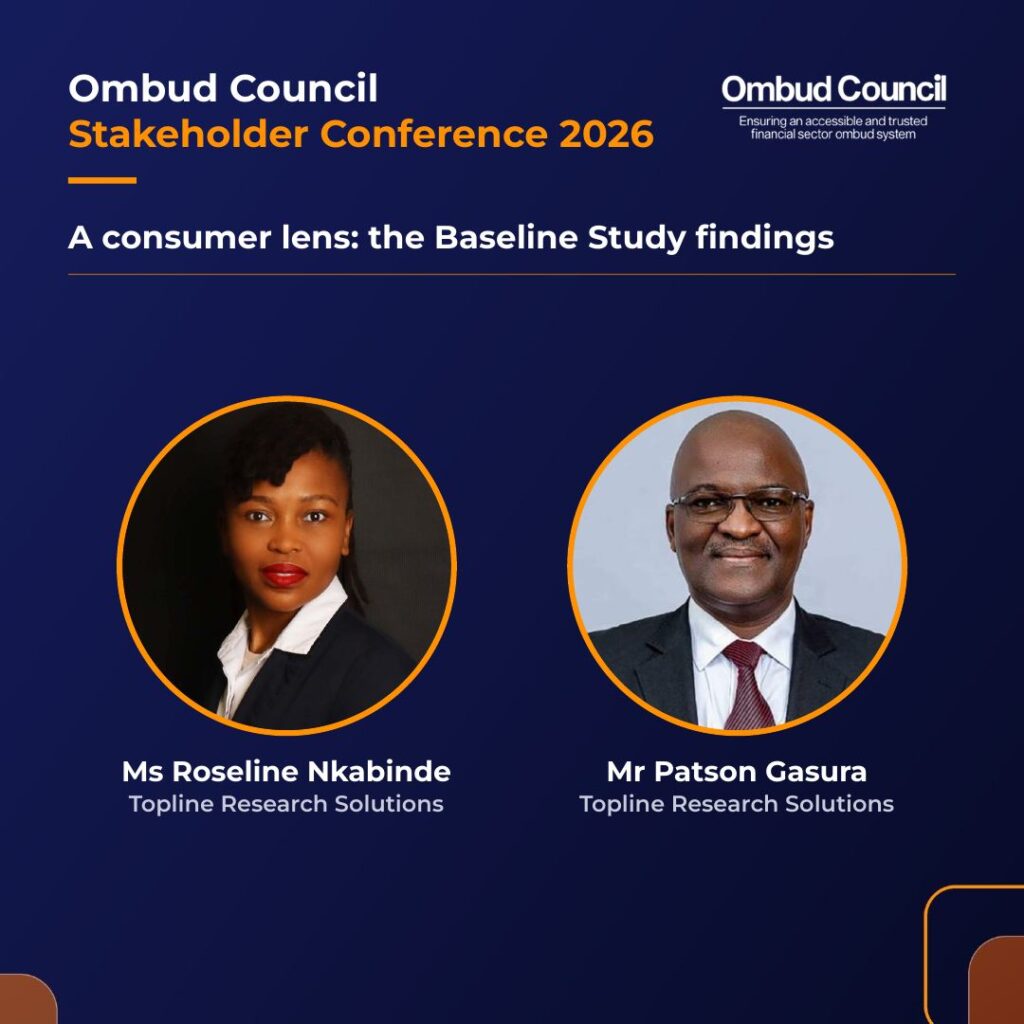
One of the highlighted sessions was titled “A Consumer Lens: The Baseline Study Findings”, presented by Ms Roseline Nkabinde and Mr Patson Gasura of Topline Research Solutions.
The presentation highlighted research involving:
- 1,520 consumers.
- 305 small and medium-sized enterprises (SMEs).
- 30 focus groups.
- 20 key informant interviews.
The research sought to bring consumer and business experiences into the discussion about financial-sector dispute resolution.
One particularly important finding stood out: one in four people who needed an ombud had never heard of one.
This finding highlights an important challenge. Although mechanisms for resolving financial disputes may exist, many consumers may not know that these services are available or understand how to access them.
The Awareness Gap: When Help Exists but Consumers Cannot Find It
The presentation used the image of a trusted clinic with a faded signpost to illustrate the awareness challenge.
The comparison captures an important reality: a service can be available, but if people do not know where to find it, they may never benefit from it.
For consumers experiencing financial difficulties, disputes or complaints, knowing where to turn can make a significant difference.
This makes public awareness an essential part of strengthening the financial-sector ombud system.
Consumers need accessible information about the services available to them, the types of complaints they can raise and the processes they should follow when seeking assistance.
Promoting Financial Inclusion Through Accessible Redress
Another important discussion at the conference was Panel 2, which focused on promoting financial inclusion through accessible redress.
Financial inclusion should go beyond access to financial products. It should also include the ability to seek assistance and obtain appropriate redress when consumers experience problems.
Accessible dispute-resolution mechanisms help ensure that consumers are not left without guidance when disagreements arise with financial service providers.
For this to happen, awareness, accessibility and trust must work together.
Consumers should be able to identify the appropriate ombud service, understand its role and know how to approach it.
Why Consumer Awareness Matters
The finding that one in four people who needed an ombud had never heard of one reinforces the importance of improving communication and public education.
Strengthening awareness can help consumers make more informed decisions about their options when they experience financial disputes.
It also highlights the importance of ensuring that information about available redress mechanisms reaches different communities, consumers and businesses.
A stronger financial-sector ombud system must therefore be supported by more than institutional structures. It must be understandable, accessible and visible to the people it is intended to serve.
Moving Towards a Simpler and Stronger Ombud System
The Ombud Council Stakeholder Conference 2026 provided an opportunity to reflect on the importance of consumer experiences in strengthening financial-sector dispute resolution.
The Baseline Study findings highlighted an important message: the existence of an ombud service does not automatically mean that consumers know about or can access it.
Closing the awareness gap is an important step towards promoting financial inclusion and ensuring that consumers and businesses know where to turn when they need assistance.
Ultimately, a simpler and stronger financial-sector ombud system must be one that people know about, understand and trust.
Consumer protection begins with awareness, but its impact is realised when consumers can access the help they need.